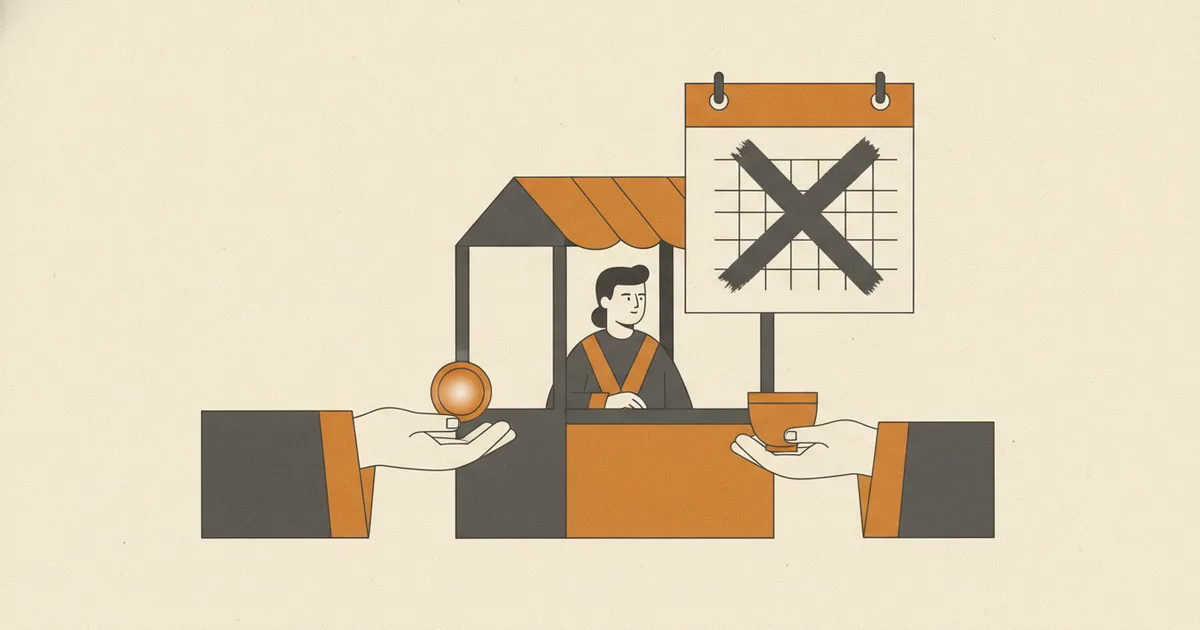
I built ReadLoud by myself, from Israel, and the one decision I get asked about most is the pricing. There is no monthly plan. There is no annual plan. You buy minutes, in packs, and they sit in your account until you use them. I want to explain why, including the parts of that decision that are worse for me as a business, because I think you deserve the actual reasoning instead of a marketing line.
The default I didn't take
Almost every text to speech product defaults to a subscription: pay a flat fee every month or every year, get unlimited use for that period. It is the standard shape for software now, not just in this category, and there are real reasons founders reach for it. Recurring revenue is predictable. It is easier to forecast, easier to raise money against, easier to plan around.
I did not take that default, mostly because of how I use products like this myself. I listen in bursts. Some months I get through a stack of long reports and a novel. Other months, nothing, because life got in the way. A subscription charges the same either way, and I have cancelled more than one app specifically because I noticed I was paying for months I barely opened it. I did not want to build the thing I keep quitting.
The honest math
Here is the actual arithmetic, not a rounded-up sales pitch. Speechify Premium is about $139 a year at the time of writing, or roughly $29 a month if you pay monthly instead. Check their pricing page for the current number, since it changes.
ReadLoud sells minutes in packs: Taste (60 minutes, $9, $0.15 a minute), Regular (300 minutes, $36, $0.12 a minute), and Binge (1,000 minutes, $99, $0.099 a minute). As a rough guide, 1,500 words of text is about 10 minutes of audio, so a typical long article costs a couple of minutes and a 300-page book runs around 10 hours.
Do the comparison honestly and a pattern falls out: below roughly 10 hours of listening a month, buying minutes tends to cost less than a flat subscription. Above that, the subscription wins, because a flat fee stops caring how much you use it and buying minutes does not. I did not pick 10 hours because it sounds good. It is roughly where the two lines cross once you work through real pack prices against a real subscription price. If your listening is heavier than that, I will tell you straight: a subscription is the better deal, and Speechify's is a reasonable one to have.
I bring this up because most companies with something to sell do not volunteer the case against buying it. I would rather you make a decision you will not regret than sign up for something that flatters my monthly revenue number and quietly overcharges you.
Why a subscription would be the easier move for me
If I only cared about my own numbers, a subscription would be the simpler choice. It smooths revenue. It removes the need to think about a per-minute cost every time someone generates audio. It matches what every competitor already does, so there is no pricing page anyone has to think twice about.
The Chargebee 2026 consumer survey reported that 67% of people would switch to usage-based or hybrid pricing if it were offered to them. That number matched what I was already hearing anecdotally from people who tried ReadLoud: a lot of the appeal was simply not the voices, not the highlighting, but the plain relief of not adding another recurring charge to a card that already has a dozen. That is a signal worth building around, even though it makes my own revenue harder to predict than a subscription would.
What "minutes never expire" actually costs
This is the part I do not see many usage-based products explain clearly, so here it is. Every minute I sell and do not deliver sits on my books as a liability, indefinitely, with no expiration date to clear it off. A subscription company recognizes revenue on a schedule and can spend it. I am carrying an open obligation to deliver audio to anyone holding a balance, this year, next year, or five years from now, at whatever my actual costs look like by then. If the underlying AI models get more expensive to run before I have delivered on old balances, that is a cost I absorb, not one I get to pass back onto a credit someone already paid for.
There is also a simpler, more immediate cost: cash flow. A subscription renews and the money is genuinely, fully mine at each renewal. Pre-paid minutes are money I am holding against a future obligation, not money I can treat as settled the moment it lands. Both of these are real downsides of the model I chose, and I chose it anyway, because I think the alternative, quietly hoping people forget to cancel, is a worse trade to make with someone's money than a slightly harder balance sheet for me.
No trial timer, nothing to cancel
One more thing that follows directly from not having a subscription: there is no trial that converts into a charge. You get 1 minute free with no account, and 20 minutes free with a free account, which just needs an email sign-in with a link or a 6-digit code, no password. Neither of those requires a card, because there is no plan waiting on the other side of a trial window to start billing you. If you never buy a pack, nothing happens. There is nothing to remember to cancel, because nothing was set up to renew in the first place.
That is a small thing on paper and a real thing in practice. A lot of the friction people feel toward subscriptions is not the price. It is the specific dread of remembering to cancel before a date, on a platform that sometimes buries the cancel button on purpose. I did not want to build a product where the best financial decision required someone to remember something on a deadline.
Where checkout stands right now
I will be straight about where things actually are today. Checkout is in open beta while I finish it properly, so packs are currently added to accounts at no charge in the meantime. The prices above are what they will cost once that is done, and the pricing page always reflects the current, real state rather than a placeholder.
Try it without a plan
If you want to see whether the math actually works out for how you listen, the fastest way is to use it. Start with ReadLoud's free minutes on something you actually want to get through, no card, no plan, and see how the balance moves. If it turns out you listen more than about 10 hours a month, I would genuinely tell you to go look at Speechify's pricing instead. That is the honest answer either way.